Marion Franklin Fleeman
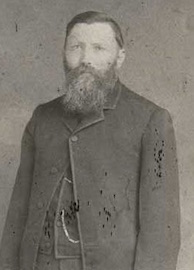
Our 2nd-great-grandfather Marion was born in 1837 in probably Franklin County, Arkansas. His mother, Rebecca L. Fleming, was widowed by the time Marion hit early adolescence (before the age of 13). He was the youngest of at least four children. According to the “Centennial History of Arkansas, Volume 3” by Dallas Tabor Herndon, Marion’s father, John Fleeman, arrived in Franklin County at a very early day and operated a mill there for a number of years, continuing his residence until the time of his death.
Possibly joined the gold rush
In 1854, before joining up with Confederate troops in 1862, Marion took an unidentified (I can’t read the handwriting in family notes, but there is a name there…) train of wagons out to California, according to fragmentary family notes. According to the same notes, Marion stayed out there for several years and also went to Pikes Peak. Such follow-on travel was actually somewhat common at the time. After the California Gold Rush (1848-1855), many traveled to Colorado for the Pikes Peak Gold Rush (later called the Colorado Gold Rush). Prospectors were active in the Pikes Peak region as early as 1859.
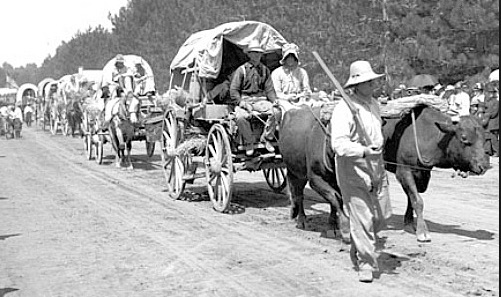
Wagon trains consisted of a caravan of wagons organized by settlers in the United States for emigration to the West during the late 18th and most of the 19th centuries. Composed of up to 100 Conestoga wagons (sometimes called prairie schooners), wagon trains soon became the prevailing mode of long-distance overland transportation for both people and goods. Wagon-train transportation moved westward with the advancing frontier. The 19th century saw the development of such famous roads as the Santa Fe Trail, the Oregon Trail, the Smoky Hill Trail, and the Southern Overland Mail route.
Meeting in early spring at a rendezvous town, the groups would form companies, elect officers, employ guides, and collect essential supplies while awaiting favorable weather, usually in May. Those riding in the wagons were directed and protected by a few on horseback. Once organized and on their way, wagon-train companies tended to follow a fairly fixed daily routine, from 4 AM rising, to 7 AM leaving, 4 PM encampment, cooking and tending to chores while the animals grazed, and simple recreation before early retirement. The companies had to be prepared for such challenges as crossing rivers and mountains and meeting hostile Indians.
Article from Britannica.com
Civil War
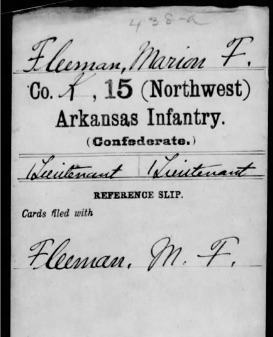
Marion enlisted in 1862 as a private in Company K of the 15th Arkansas Northwest Infantry Regiment, according to Civil War records. He became captain of Company K after 1 May 1863. According to Civil War soldier records between 1861-1865, Marion was a first lieutenant in Arkansas Infantry Company B and fought in Williamson’s Battalion. He was also involved in Hardy’s Infantry. Fragmentary records indicate Marion was captured 21 or 23 December 1863 by Union soldiers in Franklin, Arkansas and sent to military prison at Johnson’s Island, Ohio on 12 April 1864 and then to New Orleans, Louisiana 9 January 1865.
Marion may have served in the Civil War even earlier than previously mentioned records indicated. According to the “Centennial History of Arkansas, Volume 3” by Dallas Tabor Herndon, Marion first entered J.J. Walker’s company of the First Arkansas Cavalry, state troops, in the spring of 1861, a command that after the battles of Oak Hill and Wilson Creek was disbanded. He then joined an organization that became Company K, of the 15th Arkansas Northwest Infantry (as stated above and found in Civil War records), in which he became first lieutenant. After the death of Captain Krider he was advanced to the rank of captain in Company K.
15th Arkansas Northwest Infantry Regiment
The 15th Infantry Regiment (1861–1865) was a Confederate Army infantry regiment during the Civil War. The unit was originally formed as the 3rd Arkansas Infantry Battalion. After receiving the required 10 companies, the unit was re-designated as the 21st (McRae’s) Arkansas Infantry Regiment. Upon recognition that there was already a 21st Arkansas, the unit was again re-designated as the 15th Arkansas Infantry Regiment. This was the third Arkansas unit to bear the designation “15th Arkansas”. The others are the 15th (Josey’s) Arkansas Infantry Regiment and the 15th (Gee/Johnson) Arkansas Infantry Regiment. The unit saw action both west and east of the Mississippi, before serving in the Vicksburg campaign. The regiment surrendered at Vicksburg in July 1863.
When Vicksburg fell, the Northwest Arkansas men were paroled on 8 and 9 July 1863, and sent back to Arkansas to await exchange. After being exchanged, the regiment was consolidated with the 14th and 16th Arkansas Regiments to form the 1st Arkansas Consolidated Regiment. Under this final designation, the regiment served in Arkansas and Louisiana until the end of the war. Most of the men surrendered at Marshall, Texas, and Shreveport, Louisiana, in May and June 1865.
Excerpt from Wikipedia article
Marion’s marriages
Marion probably married Sarah A. Adams on 18 November 1865 in Arkansas, according to Arkansas marriage records. In her will, Sarah left everything to Marion F. Fleeman when she died on 29 May 1872. Sarah was buried in Highland Cemetery in Ozark, Arkansas with the name Sarah Alice Fleeman on her headstone.
Less than one year later, Marion married our 2nd-great-grandmother Mary Ursula “Sula” Carter 22 January 1873. Together, they had nine total children, with three children that died young, according to census data. The below list of children is missing one, which may have died in childbirth and therefore was not named:
- Bessie Lavenia Turner (1876- )
- Henry Benham
- Anna Wallace (1878- )
- Hattie Belle, our great-grandmother (1883-1970)
- James H. (1885- )
- George Jordan (1887- )
- Sula Edna (1890- )
- Thomas Charles (1892- )
Marion in the news
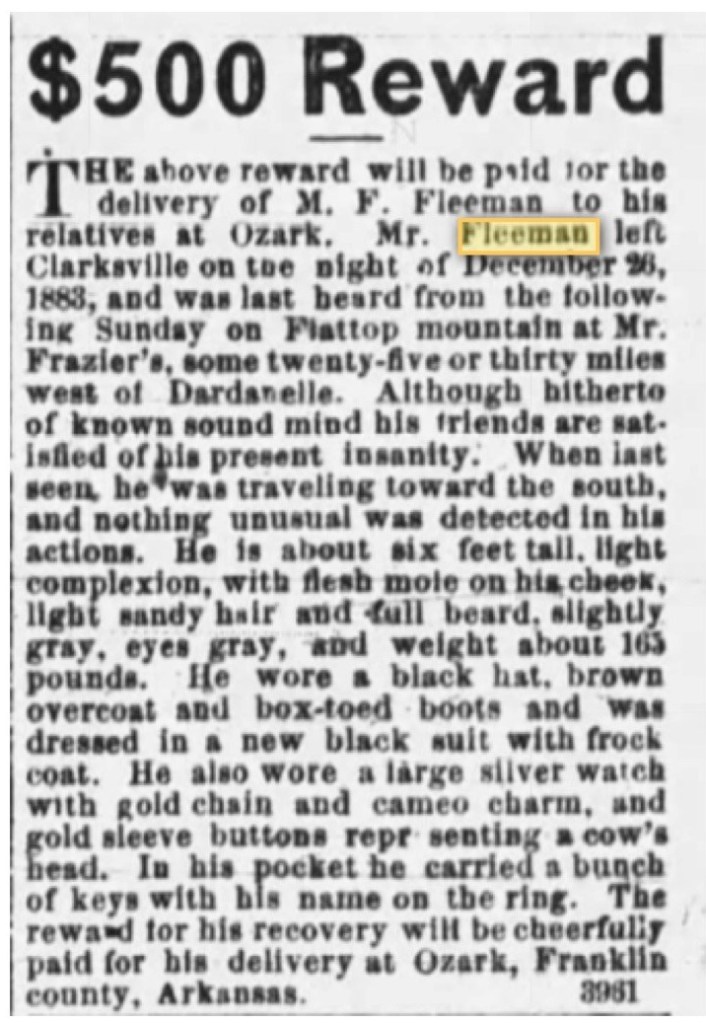
19 Jan. 1884
On 26 December 1883, Marion left his home in what local press deemed a break from sanity. According to the article, he left during the night, and was later heard from 25-30 miles west of Dardanelle on Flattop mountain. The article stated that he was last seen traveling south, offering a full description of his appearance and requesting a reward for his return.
There are additional newspaper snippets from Little Rock newspapers that mention Marion, one describing land purchases, one talking about his attendance at political events, and another naming him one of the richest men in Franklin County. Marion owned a livery business, farm property, and a ferry, which he also operated, according to the “Centennial History of Arkansas, Volume 3.” This same publication relayed the following information about Marion: he held membership in the Presbyterian church, was a loyal follower of the Masonic fraternity, and was a democrat.
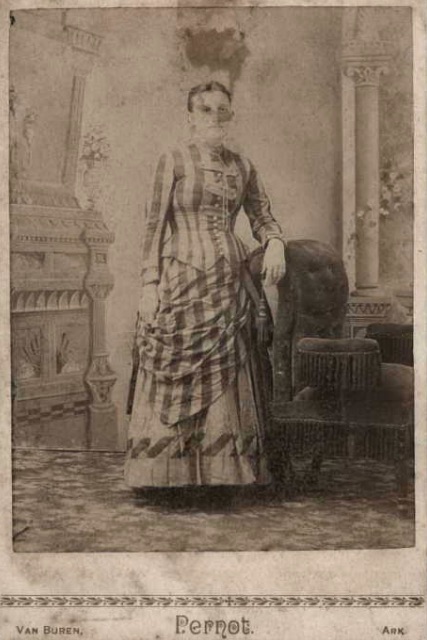
Mary Ursula “Sula” Carter
Sula was born 31 July 1853 in Mississippi as the fourth eldest child of Dr. Thomas Carter and Elizabeth Dotson Carter, according to census information. The Carter family has well-documented links to the Revolutionary War and to President George Washington! Fully exploring those links are a bit tangential to the Hix storyline, but the below paragraphs capture some of the history and significance.
Summary of Sula’s ancestors and her great-grandfather’s Revolutionary War service:
Sula’s father, Dr. Thomas A. Carter, was born in Amerst County, Virginia on 31 March 1819, into one of the first families of Virginia. He was a well-known physician of Ozark, Arkansas, married to Elizabeth B. Dotson. Dr. Carter’s father, Thomas S. Carter, grew to manhood in Virginia, and was a soldier in the War of 1812. He married Harriet H. Aldridge, also a descendant of a prominent family, and in 1824, they moved to Alabama, where Thomas engaged in farming until his death in 1833.
Sula’s great-grandfather John Champ Carter probably entered military service as an ensign of the 7th Virginia on 18 March 1776. He resigned from that outfit on 15 January 1777, according to Heitman’s Historical Register and Soffell’s Records of the Revolutionary War. He then served as a captain in Colonel Harrison’s Virginia Artillery (also known as the 1st Continental Artillery) from 30 October 1777 to an undetermined time. During his time in the Virginia Artillery, he was part of Company No. 7 as it stood at Valley Forge on 3 January 1778. John was recorded as being in service as of November 1778 and was taken prisoner at Charleston on 12 May 1780. He was held prisoner until the end of the war.
“History of Benton, Washington, Carroll, Madison, Crawford, Franklin, and Sebastian Counties, Arkansas”; family application to the Daughter’s of the American Revolution; Bureau of Pensions information; Soffell’s Records of the Revolutionary War; and Heitman’s Historical Register of Officers of the Continental Army 1775-1783 (p. 147).
Carter family links to President George Washington
Sula’s 2nd-great-grandfather Colonel Fielding Lewis was twice married — first, in 1746, to Catherine Washington, a cousin of George Washington; she died in February, 1750. His second wife was Elizabeth (Betty), the sister of George Washington, whom he married in 1750. He was proprietor of half the town of Fredericksburg, and of an extensive territory adjoining. During the Revolutionary War, he superintended the manufacture of arms in his neighborhood. He was a local magistrate for many years, and often represented his county in the Legislature. He died in December 1781 at the age of 55.
Lossing’s Field Book of the Revolution, volume 2, p. 427; family application to the Daughter’s of the American Revolution; Gilmers Georgians Lewis Genealogy
Deaths and Burial
After having 9 children with Marion between 1876 and 1892, Sula was tragically widowed in 1899. She became a landlord, according to census data, probably to bring in extra money and support her children. Sula continued to live in Franklin County, in either Ozark City or the White Oak area, according to census data, until her death on 23 June 1925 and burial in Highland Cemetary in Ozark.
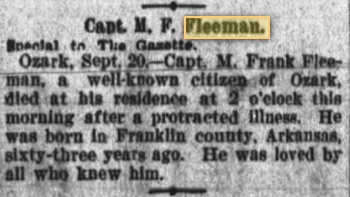
Marion died he died 20 September 1899. His obituary can be found below:
 hixstory.family.blog